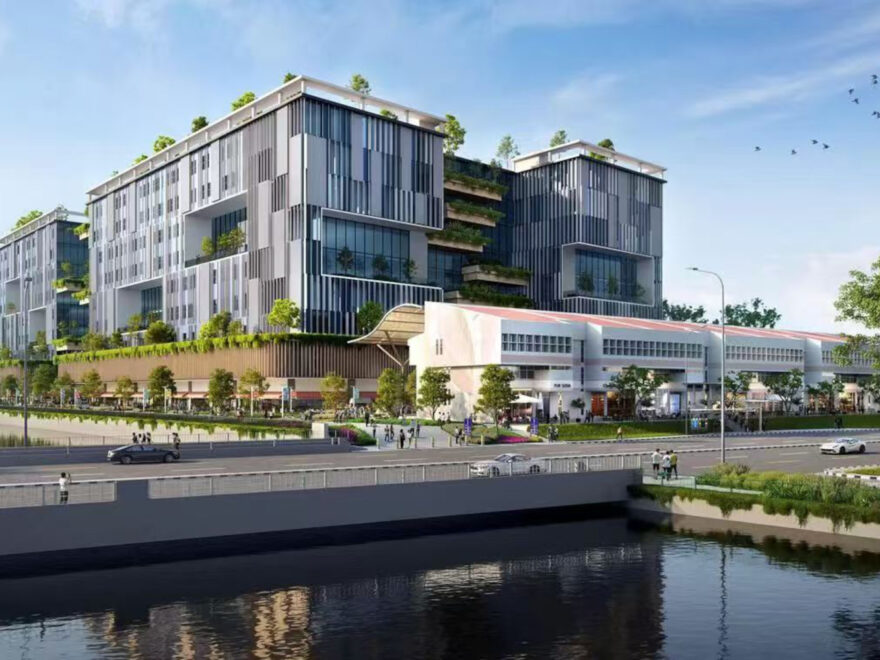
Singapore’s status as a global food paradise tends to summon mental associations of hawker stalls, Michelin-starred dining and cutting-edge fine cuisine. But beneath this colourful food scene lies an advanced and dynamic food manufacturing industry, the cornerstone of the nation’s food security and its goal to be a world-class hub for food innovation. With the scarcity of land increasingly becoming a reality, the physical spaces designed for food production are in urgent need of rethinking. This is the platform for Gourmet Xchange by CapitaLand Development (CLD), a game-changing concept that will change your perception of what a contemporary Singapore multi-user food factory should be, with its mix of industrial function, connection and heritage preservation).
Gourmet Xchange is a series of commercial premises and also an investment in Singapore’s food industry – one that is designed to be more sustainable, resilient and future-focussed than what Singapore has seen so far. Situated in the established industrial estate of Kolam Ayer at Kallang Way, this nine-storey property will be an integrated building equipped to cater for a range of food-related end-users including manufacturers, central kitchen operators, caterers and storage providers. In doing so, CLD is tackling the operational challenges of expensive and production-stifling buildings that can otherwise be found in food production in older, unsuitable spaces busting at the seams for developing businesses to increase scale and turnover – a perfect fit with our national ambition of growing better local food.
The Architecture of Flexibility and Tradition
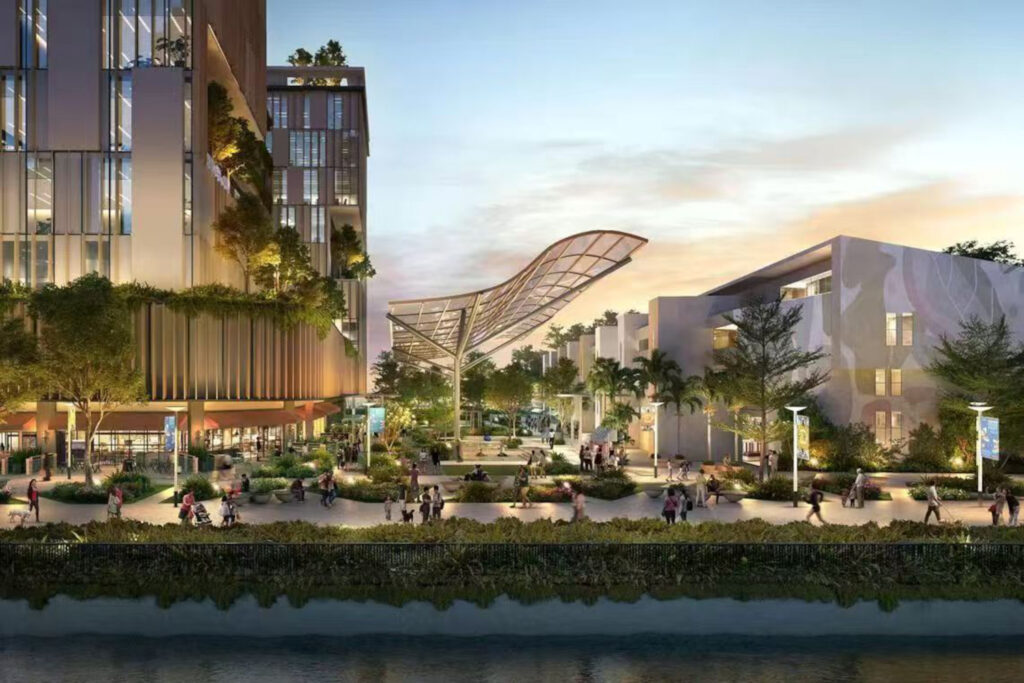
A very distinctive section of the Gourmet Xchange project is its focus on adaptive reuse reclamation and industrial heritage preservation. CapitaLand Development clinched the tender for the Kallang Way Industrial Government Land Sales (IGLS) site with a concept that preserves and refashions the oldest three-storey terrace-showroom factory cluster still existing since the 1980s. The requirement is a respect of Singapore’s industrial architectural heritage, and its adds an unique character to the modern development.
The preserved block, and parts of the new factory fronting Aljunied Road, are to house retail and F&B outlets as well as entertainment options. This not solely adds life to the place, but also brings much needed conveniences to the dwellers or workers of Gourmet Xchange and even for people who are staying around such as Paya Lebar estate and Macpherson estates. The chipped and the new, the industrial and the local – a new standard for estate planning.
The new 9-story multi-user food facility is designed for performance. Knowing food production has heavy-duty requirements, the building will include a full ”ramp-up” access system that will enable 40-foot container trucks to drive directly to the unit entrance on every floor. In logistics terms, this is hugely beneficial as it simplifies the process of bringing raw materials in and finished goods out, an important consideration when you’re working at a pace (and on a scale) such as food factories. The building also offers big floor plates, which can be anywhere between 3,000 and 7,000 square feet usually on flexible floors with additional possibility for expansion in the future. The floors will offer heavy-duty floor loading and high floor-to-floor ceiling heights (up to 6.65metres) that cater for a wide range of processing layouts – including vertical production systems, and heavyweight equipment mobilisation – making the bridge hub suitable for anything from traditional central kitchens to state-of-the-art food technology labs.
An Ecosystem for Innovation and Food Security
The date and venue of Gourmet Xchange are no coincidence. Singapore has been aggressively promoting the Food Manufacturing Industry Transformation Map (ITM) as part of the government’s vision of growing Singapore into Asia’s leading food and nutrition hub. This vision was reinforced with the “30 by 30” food security goal (refashioned more recently in terms of specific protein and fibre goals by 2035). An efficient, innovative and adaptable local food production industry is thus required to meet these national aspirations. As a whole, Gourmet Xchange also directly supports that by being the physical infrastructure solution for companies to modernize and automate and grow their businesses.
The dedicated assets of the facility are revolutionising food manufacturing. Every unit is equipped with what you need to safely and hygienically prepare food in accordance with strictest food safety guidelines, including HACCP conform design elements. These might include separate entrances for raw and finished food to avoid cross contamination, vented kitchen ways, grease traps, adequate draining (all drains must be air gaped), electrical supplies. Through providing a “plug-and-play” ready building, Gourmet Xchange dramatically reduces start up costs (and time to market) for tenants. This is especially a win for SMEs (small-and medium-sized enterprises) and food-tech start-ups that have to scale from R&D or a pilot plant to a commercial production in no time. The concentration of food-linked businesses at the hub will also help create a ‘synergistic ecosystem’ and facilitate networking as well as sharing ideas for collaboration on supply-chain or product development, it added.
Connections: The Logistical Edge Recipe
Location is often everything in Singapore, a convenient advantage to logistics. Gourmet Xchange at Kallang Way is literally located at the heart of Singapore, with great accessibility to all corners of the island which makes it highly advantageous in all aspects for food manufacturing. It is also centrally located next to major highways such as the Pan Island Expressway (PIE), making distribution island-wide quick and easy. It also has easy access / only minutes away to several Mass Rapid Transit (MRT) stations including Aljunied, Geylang Bahru, Macpherson and Mattar. This outstanding access to public transportation is essential for the workforce, reducing commutes for employees and allowing tenants to compete effectively in a tight labor market.
More than mere physical connections, the design also encourages digital and operational connections. Ramp up access in turn facilitates delivery while separation of service, goods and passenger lifts provides for even more efficient internal movement with minor crossover that could cause bottlenecks throughout the working day. This cradle-to-grave infrastructure approach means food manufacturers can concentrate on the business of making and innovation and free themselves from the headaches oftentimes present when trying to operate in general industrial space. With reduced time and increased productivity on the operation floor, Gourmet Xchange means less cost and more return to its tenants.
Investor confidence and The Future of Food Spaces
The Gourmet Xchange is proving its soundness with its favorable market response and business investment desirability. The top bid by CapitaLand Development for the site, together with likeminded capital partners such as an affiliate of Fraxtor Group which has successfully offered fractional investment opportunities, reflects confidence in the prospects for future purpose-built food facilities. Such a huge level of investment indicates the market’s belief that existing food manufacturing infrastructure remains both a secure and critical element of Singapore’s economic future.
Into the future, Gourmet Xchange is a physical expression of what industrial real estate will look like in Singapore. It shows that industrial spaces can be high-tech, energy-efficient and eco-friendly while enhancing the quality of the built environment and preserving a country’s architectural heritage.
As Singapore grapples with global food supply threats and doubles down on its “Singapore Food Story,” supporting a strong, contemporary, well-positioned infrastructure like Gourmet Xchange is a priority. It is also a vital piece in the puzzle, offering the physical launchpad for the next generation of food innovators, enabling them to take what they come up with in their lab-growths and fancy automation and turn it into commercially available realities that will feed the nation and export Singapore’s Taste to world. So rather than being just a building, Gourmet Xchange is an essential driver not only for the island’s food sovereignty; but also to its economic dynamism in the 21st century.
Source: https://www.gourmet-xchange.net/